3.2.9.1. Introduction
The purpose of this section is to describe, for the first time, the automation of nephelometry and turbidimetry by programmable Flow Injection, performed with the hybrid flow cell designed to monitor turbidity in either nephelometry or turbidimetry mode, while thus obtained spectra are recorded by a CCD spectrophotometer.
Turbidity is a measure of the cloudiness of a fluid, caused by individual suspended particles. It is an important parameter in many fields, such as immunology, biomolecular interactions, pharmacology, and in the monitoring of fermentation and processing in the chemical industry. Since turbidity is widely used for the evaluation of water quality in oceanography, we analyzed, in this work, samples of drinking and sea water to compare results obtained by FI Nephelometry with FI Turbidimetry and compare their performance.
Nephelometry of suspended particles measures increase of radiation reflected at 90 degrees to incident light beam (A). The method is said to be more sensitive than turbidimetry because the reflected light is monitored against a dark background. Therefore, nephelometry is widely used standard method in US (EPA 180.1) and EU (ISO 7027). Turbidimetry was not standardized in the US while ISO recommends its use for high turbidity samples.
.png.aspx "3_2_9-1-(1).png")
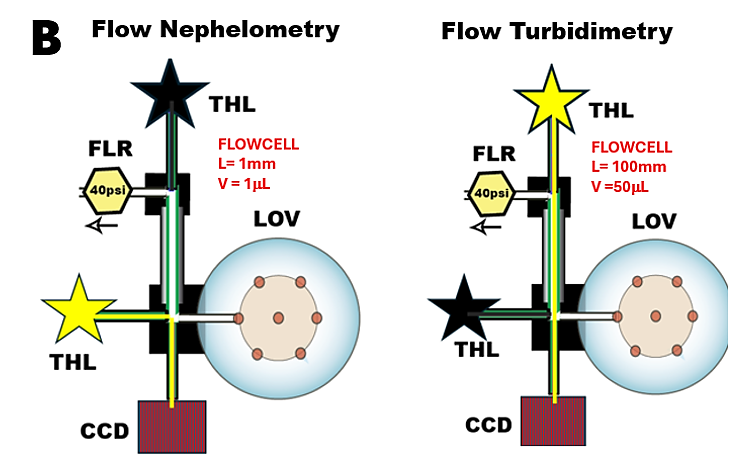
Turbidimetry measures the decrease of transmitted light due to scattering by suspended particles. The detector is placed at 180 degrees (in line) with the light source, and the sensitivity is, supposedly, less than that of nephelometry, because the loss of light is monitored against the brightness of the light source. In this work we show that turbidity is directly proportional to the absorbance, defined by the Lambert Beer Law and measured by spectrophotometry. The unique construction of the hybrid flow cell (B) allowed us monitoring in either nephelometry or turbidity mode on the same sample and thus compare their sensitivities.
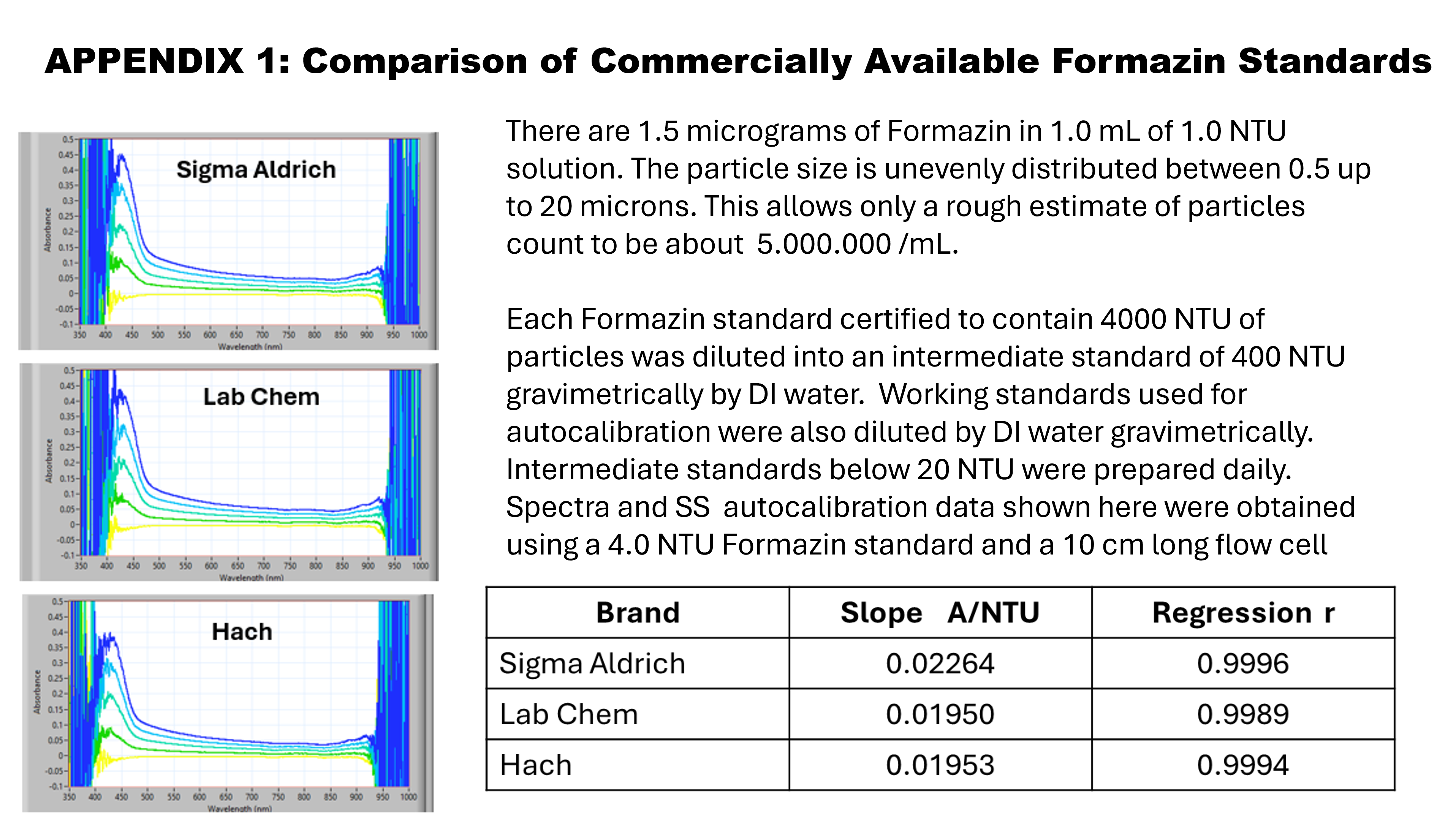
Standard materials. In contrast to spectrophotometry, where Absorbance is well defined by molar absorptivity at a given wavelength, the unit of nephelometry is empirical, based on the suspension of particles of Formazin, which is synthesized by reaction of hydrazine sulphate with hexamethylenetetramine. This stabilized suspension of irregularly shaped particles sized to about 1.5 μm with a distribution ranging from 1 to 20 μm is available from several vendors. In this work, we used the 4000 NTU certified standard by Sigma Aldrich (Supelco). Comparison of calibration data of certified Formazin standards from other vendors are in Appendix 1.
Units. Nephelometric Turbidity (NTU) and Formazin Nephelometric Unit (FNU) are said to be equal being both based on the commercially available standards sold as 4000 NTU measured in nephelometry mode while using a “broad white light” from tungsten halogen lamp (EPA). However, it is termed FNU by ISO which uses infrared illumination at 880nm. To avoid confusion, we will label all data in this work as NTU because we use tungsten halogen lamp (THL) light source and 4000 NTU Formazin as primary standard.
Turbidimetric data, measured by spectrophotometer in 180 degree light beam configuration (B right) in absorbance units A, will be converted to NTU units by analyzing the Formazin standard while monitoring decrease of light intensity at a specified wavelength. Thus as in spectrophotometry when absorbance A is always specified by the wavelength of the monitored radiation, turbidity will also be specified by the monitored wavelength, rather than by the emission spectrum of light source. Comparison of the spectra of light scattered by Formazin with the spectra of analyzed suspensions will facilitate the choice of the optimized wavelength for analysis and the relevance of the obtained NTU values (See Results below).