3.2.9.2. Nephelometry
Method and Instrumentation
The platform for automation of nephelometry the mini SIA-2 instrument (Global FIA, USA), is designed to perform microfluidic manipulations of samples in programmable flow mode (Sections 3.2.6. & 3.2.7.). The sample processing manifold the Lab-On-Valve LOV is furnished with a hybrid flow cell initially designed to monitor either absorbance or fluorescence (Section 3.2.8.).
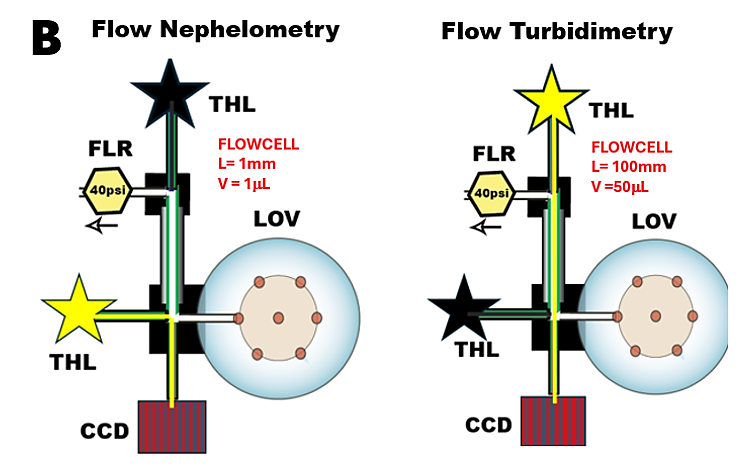
The flow cell configured for nephelometry (B left) is attached to the LOV manifold by a black block that accommodates two optical fibers: the illumination fiber connected to Tungsten Halogen Lamp (THL) and the collecting fiber leading to CCD Spectrophotometer. Configurated at 90° and 1 mm apart optical fibers form an illuminated volume of approx. 1 μL. The flow cell is pressurized at 40 psi by means of a flow restrictor (FLR) to prevent the formation of microbubbles by outgassing.
Calibration by Formazin suspensions
The calibrations were obtained by using a flow program designed to automate the dilution of the 20 NTU standard formazin sample prepared in DI water, in five steps, by the carrier solution of deionized water. In the first step of the flow protocol (C), sample suspension is aspired into holding coil 1 (HC1) along with carrier solution (DI) the volume of which is sequentially increased to obtain desired dilution. For details of this Single Standard Calibration (SSC) method see (Section 3.2.5.)
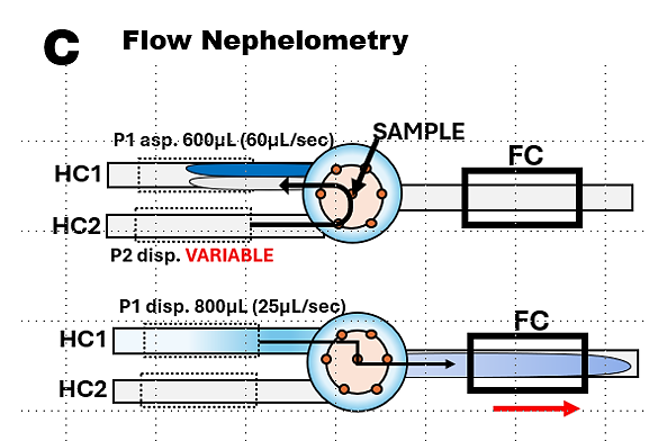
In the second step of the flow protocol the diluted suspension is transferred into and through flow cell at a continuous flow rate at 25 microliters per second. Microfluidic manipulations data collection and data evaluation are controlled by software protocol (D).
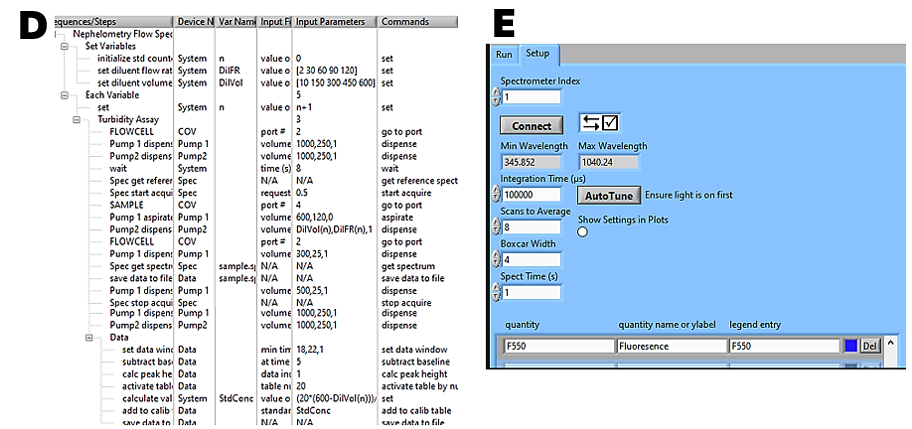
Since in the nephelometry mode the Spectrophotometer will monitor the radiation reflected by suspended particles it has to be set up to function in the fluorescence mode (E). For details see (Section 3.2.8.2.).
Results
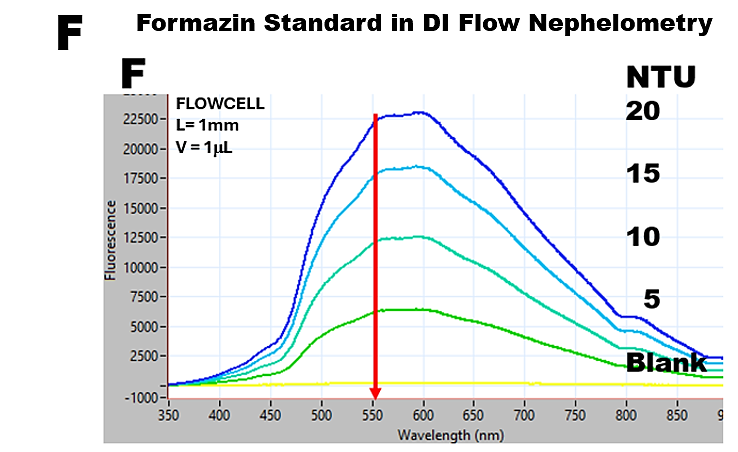
Data collected from serial dilution of 20 NTU standard prepared in DI water are presented in three formats: spectra versus concentration (F), concentration versus time (G), and the resulting calibration graph (H).
.png.aspx "3_2_9-6-(1).png")
.png.aspx "3_2_9-7-(1).png")
The recorded spectra show the same pattern as the emission spectrum of the TH lamp because particles of Formazin are white and reflect radiation in direct proportion to the concentration of particles. Therefore, obviously, the calibration data must be specified for a certain wavelength of reflected light. To maximize intensity of illumination (by TH lamp) and resulting response, we have chosen 550 nm in contrast to the prevalent use of 750 nm or rather broad EPA specification of a ’white light’ (400 nm to 600 nm). The experimental runs of concentration versus time (G) recorded at a forward flowrate of 25 μL/s, show at 13 seconds sharp increase of reflected light from baseline level (BS) to a plateau within which a data collection window (WIN) is situated. While during continuous flow the response is usually peak shaped, here the unusually small volume of the flow cell (1 microliter) scans 400 μL of a stable concentration of suspension for 15 second periods, after which the tail section of a more dispersed zone is flushed out from the flow cell.
The calibration graph (H) in the range 0 to 20 NTU, is strictly linear, of good reproducibility resulting in excellent limit of detection (LOD 0.09 NTU) and low blank value 0.11 NTU. These parameters indicate that this method is potentially suitable for determination of suspended matter (SPM) in sea water in Open Ocean (typically 1 NTU) or in estuaries (40 NTU), where, however, salinity varies considerably. Since the above calibration data were obtained by sequential dilution of a 20 NTU standard prepared in DI, by a carrier made also of DI (pump 2), this calibration is obtained at zero salinity and thus may not be applicable to the analysis of seawater.
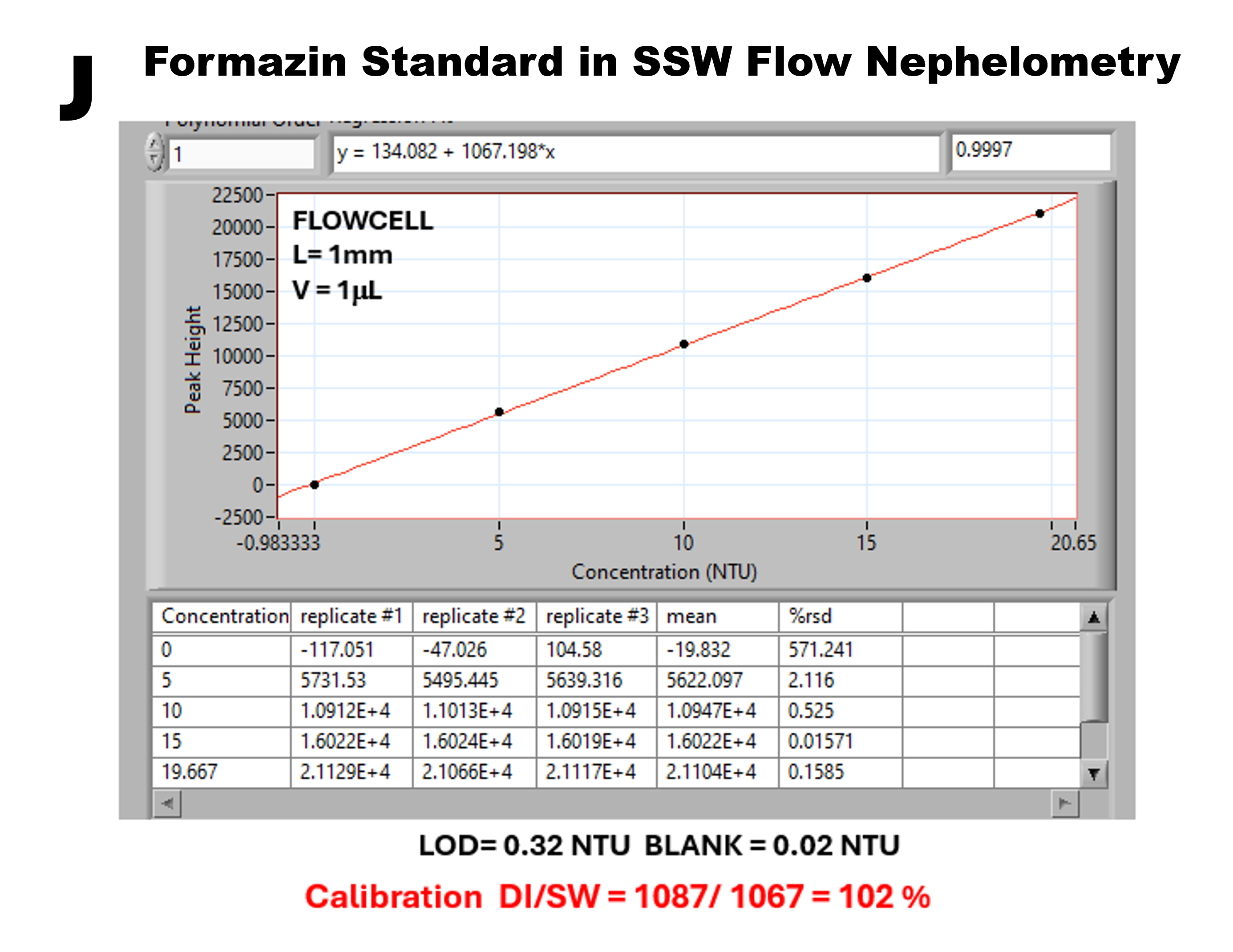
Therefore, sea water calibrations were obtained Simulated Sea Water (SSW) prepared by 3.5% NaCl in DI, which approximates salinity in open ocean water (35 PSU). The SSW was used to prepare a 20 NTU standard and also as a carrier supplied by Pump 2. The data obtained by SSW water calibration are presented in two formats: 1) time versus concentration (I) and 2) resulting calibration graph (J). There is no visible difference between time/concentration responses of DI and SSW runs (G & I) while DI and SSW calibration data are virtualy identical. Therefore and because of the ratio of slopes of calibration lines differs by only 2% (J), DI based calibration can be used for the determination of suspended particulate matter (SPM) in sea and brackish waters.
.png.aspx "3_2_9-8-(2).png")